
.jpg)
Pakistan Eyes Deeper Economic and Defence Ties with Egypt, Says Ambassador
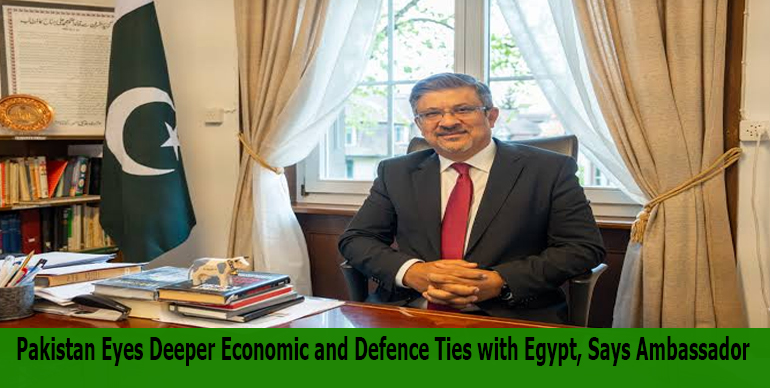
In an in-depth interview with Daily News Egypt, Pakistan’s Ambassador to Cairo, Aamir Shouket, detailed the robust and evolving relationship between the two nations. Against a backdrop of significant regional instability, Ambassador Shouket discussed the extensive cooperation in defence and counter-terrorism and outlined a clear vision for expanding the modest $300m trade volume by leveraging untapped potential in sectors ranging from information technology and tourism to mining and agriculture. He also elaborated on Pakistan’s official stance on the devastating war in Gaza and the escalating tensions between Iran and Israel, underscoring a shared commitment with Egypt to pursue diplomacy and de-escalation. In light of the current changes and rising uncertainty in the region, can we expect a greater rapprochement in defence and security between Egypt and Pakistan in the upcoming period? Yes, we have very good ongoing cooperation; our military-to-military cooperation is strong. If you look back at the recent past, we have participated in the Bright Star exercise and some other exercises. Egyptian troops have visited Pakistan to join us in exercises, and they participated in the Defence Expo in Pakistan. Numerous delegations visit. Our Chairman of the Joint Chiefs of Staff Committee visited Egypt, and there is a planned visit in the near future as well. The joint committee covers a range of subjects. We also have a military officer undergoing training here at the Nasser Higher Military Academy, and an Egyptian officer is training in Pakistan. So that kind of training is also ongoing. I am pretty satisfied with the level of military-to-military cooperation, which is very strong and gaining further strength, and hopefully will continue to do so in the years to come. Regarding terrorism, has there been any development in cooperation between Cairo and Islamabad on counter-terrorism efforts? Yes, we have a very close collaboration. I cannot speak about the details, but yes, I can say that there have been joint exercises as well. Do you think the current levels of economic and trade cooperation are satisfactory, and how can joint trade and investment be boosted? This is one area where we can say that the trade and investment between our two countries are not up to their potential.Our bilateral trade, both ways, is around $300m, plus or minus. But we think, and Egypt thinks the same way, that there is much more room to grow. There may be one odd sector where we compete, but we also complement each other. I’ll tell you how. Egypt, like Pakistan, is known for producing high-quality textiles and cotton products. Egyptian cotton, of course, is very exclusive in the world, so it goes to very exclusive brands. Other Egyptian brands then need yarn and fabric to produce in their factories, which comes from Pakistan, because we are also one of the largest cotton-producing countries. Our cotton may not be as exclusive as Egyptian cotton for the very high-end brands, but for your day-to-day products, it’s very popular in the world, be it home textiles or ready-made garments. Most importantly, Egypt also offers very fertile ground in the sense that there are these exclusive economic zones. Egypt’s position as a gateway to Africa and its proximity to Europe also makes it very attractive for business people from Pakistan to come and set up their industrial plants here. Already, there are a few: at least two textile factories and one which camerecently for football manufacturing. You would probably know that Pakistan is the leading football manufacturing nationin the world, particularly the match balls. The footballs used by Adidas for the FIFA World Cup, the Euro League, and the Bundesliga are all made in Pakistan. Now, such a factory has been set up in Egypt by a Pakistani group, and we are happyto note that a number of footballs will now be produced here in Egypt for events like the World Cup and for UEFA. And what about Egyptian investment in Pakistan? What sectors do you think Egyptian companies could explore? Investment going the other way, into Pakistan, is also important, because Egypt has acquired excellence in a number ofareas. For example, high-end property development, where Egypt has become very popular. There is a major Egyptian group which has been in Pakistan for many years. To begin with, they were the owners of the biggest mobile phone operator in Pakistan, which they sold. But now, for a few years, they have entered the property development market. They have established one of the best properties in Islamabad, with a golf course like the many you have here in Cairo, with modern, European-standard villas. It has become very popular, although it’s for high-end users, but we needed such a thing. The other sector, which is very important and where we can learn and benefit from Egypt, is tourism. The Egyptian tourism sector is very well-advanced. We have so many touristic places in Pakistan, but of a different nature. You offer more antiquities and, on the other hand, the Red Sea; we have high-altitude mountains, skiing, and trekking. But the basics are the same: hospitality, training, the management of tourists, and the management of the industry itself. That is another area where there is a lot of potential for Egyptian companies to come. One other area I don’t want to forget to mention is the mining sector. Pakistan has recently opened up this sector forinvestment, and there has been an indication by certain Egyptian groups that they are interested. Pakistan is sitting on a wealth of mines and rare earth metals, from copper and zinc to gold. There has been investment that came in, but we want more to come in. So that is one area where we see a lot of potential for working with Egypt. Has the Pakistani government introduced any new incentives to attract foreign investment in these sectors? Exactly. For the past two years, the Government of Pakistan has established a new body called the Special Investment Facilitation Council (SIFC). The necessity to set up this body arose because Pakistan is a federal republic, and by constitution, our provinces are autonomous in taking their own decisions. This was causing a bit of confusion and bureaucratic problems for investors. First, they had to get permissions from the province, and then from the federal government, dealing with licensing and which fee to be paid where. It was becoming very cumbersome. At times, some investors also raised security concerns. That is why an informed decision was taken by the government to set up a body backed by legislation, so that a decision, once taken, cannot be undone by successive governments if there is a change. It also has the backing of the law so that it cannot be challenged in the courts. The body is chaired by the Prime Minister himself, and we also have the military present in it to provide assurance and confidence to the investor that there will be an element of security, because the military has a presence all over the country. With the presence of all the provinces, we have now made this a one-stop shop for investors. You don’t have to go anywhere else; you just go to SIFC, and that’s it. The other linked step is the simplification of the visa process for Pakistan, which includes Egypt. It’s for about 126 countries. It’s a visa-prior-to-approval system. You just sit in front of a computer, upload your picture, a copy of your passport, and fill in a few columns. No fee, nothing. Just submit it, and within 48 hours, it’s in your email. You don’t need to send your passport anywhere, no stamp, nothing. Just print the paper and travel. It’s for up to 30 days, but if you become an investor and want a longer visa, you can get one for five or ten years through the same online process. We have taken care of that so that investors aren’t running after the visa thing.For More Details Click Here